


A context clues anchor chart is a necessary tool for elementary grades. It can help students understand unknown words while reading nonfiction texts. Since context clues and vocabulary words will continue throughout the entire year, I suggest leaving one of these anchor charts up for the entire year to help. In this post, I’m sharing a few anchor chart ideas for context clues that will help your students become word detectives during any nonfiction reading lesson.
#1: Introduction to Context Clues Anchor Chart

This anchor chart is an excellent introduction to context clues. It helps students learn how to use the surrounding words and phrases to determine the meaning of an unfamiliar word. With a simple three-step process, students can see just how easy it can be to figure out the meaning of an unknown word.
The anchor chart can be simple:
- Write “Context Clues” across the top, to label the chart.
- Record a simple, clear definition below the label.
- Divide the chart into three columns.
- Look at the WORD.
- Look at the SENTENCE.
- Access your SCHEMA.
- You can record guiding questions in each section, as well. Leave enough room to add sticky notes or write on/wipe off examples for each part of the process.
#2: “IDEAS” Types of Context Clues Anchor Chart

Next, you’ll want to illustrate each type of context clue, including Definition, Antonym, Synonym, Example, and Inference. I like to use the acronym IDEAS to make it easier for students to remember the 5 most common types of context clues. Again, leave space for interactive examples of each type. Be sure to encourage your students to use this chart when identifying context clues when they encounter unfamiliar words.
#3: Types of Context Clues Option 2

This context clues anchor chart helps students refer back to whenever they encounter new words in nonfiction passages. Build confidence and independence as they learn to decode word meanings on their own.
#4: Context Clues in Action in Mentor Texts

You will want to have a context clues anchor chart for continued practice. You will use this chart to effectively apply the skill within real texts. Highlight words and passages in real books students can easily access from your class library, or printable texts you’re reading together.
Anchor Chart Longevity Tip
To keep your context clues anchor chart reusable I recommend laminating it! This is great for easy reuse and storage. Plus, you can write on/wipe off or use sticky notes to make them endlessly interactive!
Grab these Ready-Made Reading Units!
Find standards-based learning for grades Kindergarten through fourth grade! Each unit comes complete with lesson plans, graphic organizers, comprehension passages, task cards, assessments, and more!

Kindergarten Context Clues RI.K.4

1st Grade Context Clues RI.1.4

2nd Grade Context Clues RI.2.4
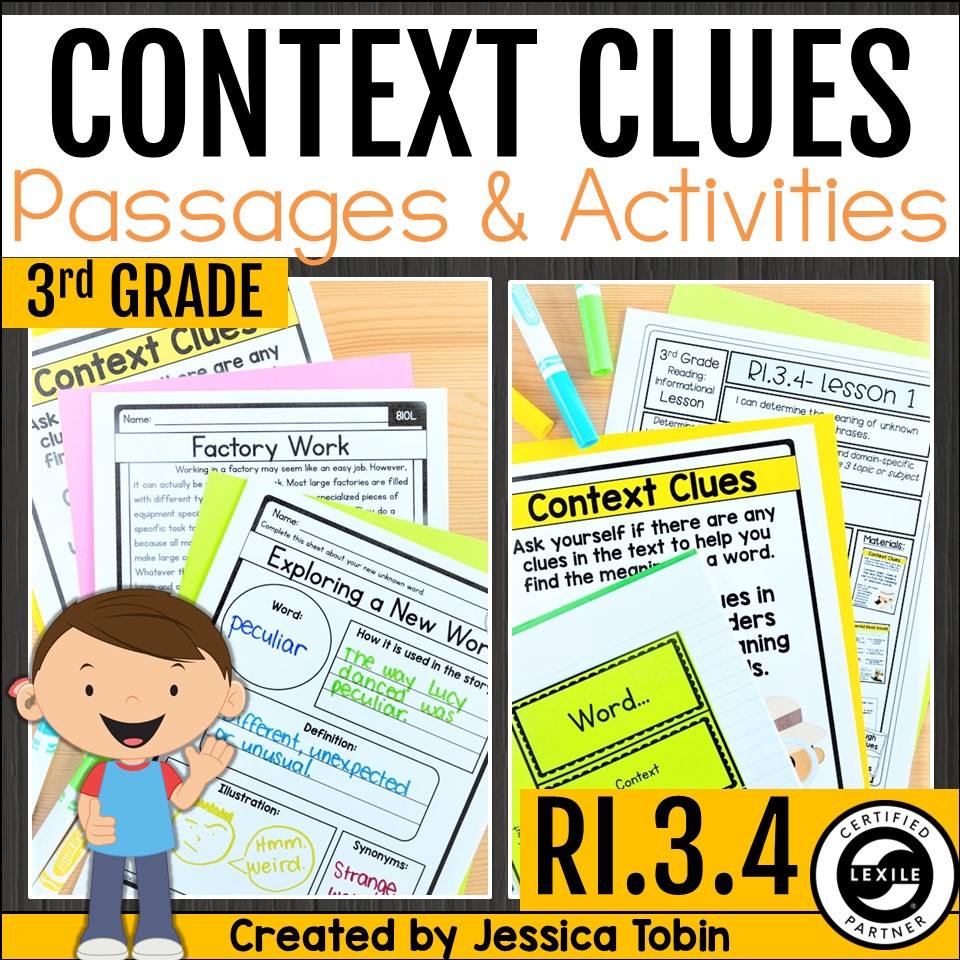
3rd Grade Context Clues RI.3.4

4th Grade Context Clues RI.4.4

5th Grade Context Clues RI.5.4
Want a FREE context clue activity set?
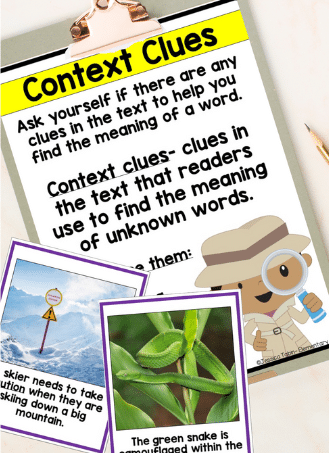
Want a Context Clue FREEBIE?
Simply choose your grade level: