

When teaching the language skills connected to types of sentences, break it down by standard! Students move through several stages of sentences skills, starting with complete sentences all the way to producing simple, compound, and even complex sentences. Here is the Common Core break-down of this standard across grade levels:
- Kindergarten (L.K.1.f) complete sentences
- 1st Grade (L.1.1.j) simple, compound; types of sentences
- 2nd Grade (L.2.1.f) simple and compound sentences
- 3rd Grade (L.3.1.i) simple, compound, and complex sentences
- 4th Grade (L.4.1.f)- complete sentences; fragments and run-ons.
Step 1 – Start With Incomplete & Incomplete Sentences

Source: L.K.2.f
In Kindergarten, students can begin to produce sentences. This activity can include building short sentences with parts or identifying sentences that are complete or incomplete. Using a simple task, like the one above, can help students strengthen their understanding of sentences.
In first and second grades, the activities can increase in difficulty. Activities, similar to the one in the next section, are good for students developing writing skills. Have students produce their own sentences on a topic or idea. Spending adequate time in the sentence production stages of teaching sentences will be essential!
Step 2 – Types of Sentences Introduction

Source: L.1.1.j
One of the first steps in How to Teach Sentences to Students, there will need to be explicit instruction on the four types. Starting in first grade, students should be able to identify the four sentence types. These include declarative, imperative, interrogative, and exclamatory. Starting out, I always recommend starting a topic with an anchor chart. This can be teacher-made, or digital/printable, like the one above! While students are learning about content skills, they can always refer back to the anchor chart to support understanding and correct misconceptions. Then, they’ll become more comfortable with the types of sentences they’re working with.
Source: L.2.1.i
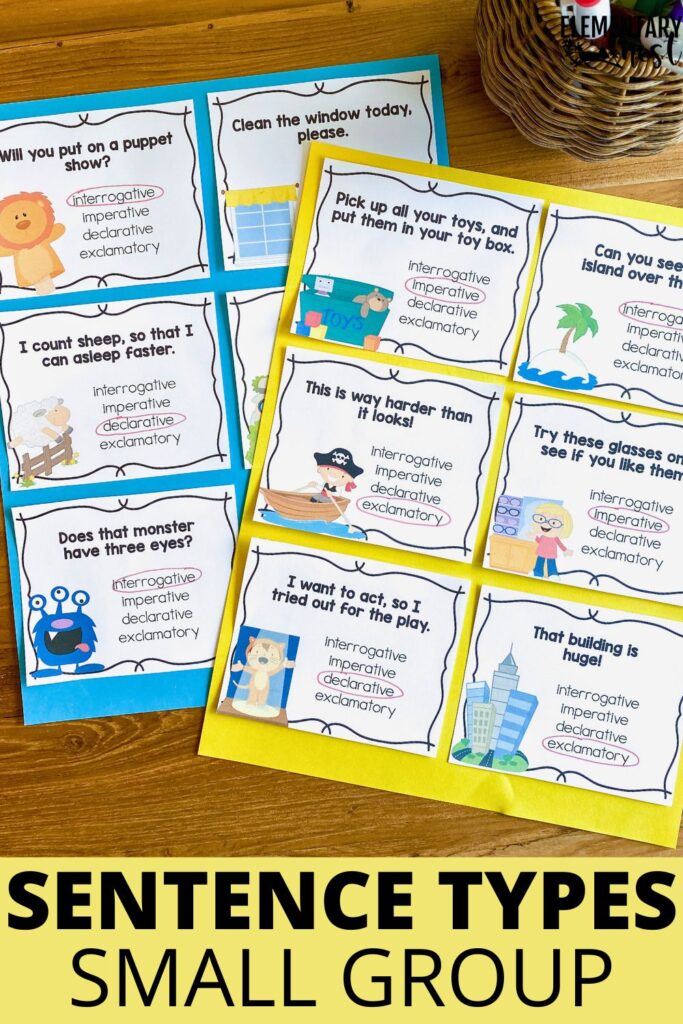
Then after explicit instruction, students will need to apply their skills. During this time, partner/group/independent activities are a great supplement to your instruction! In the activity above, students read sentence examples and identify their type. This has students working on a skill and building their experience.
Step 3 – Difference Between Simple and Compound

After teaching sentence types, you can move into simple and compound sentences. Another skill, another anchor chart! Help students understand the concept of subject and predicate (or verb in younger grades). They will need to know “who” and “what”, who the sentence is about, and what they are doing. Remember to teach students that who doesn’t just mean a person. It is “who” because it is the subject of the sentence.

Then, as students begin to understand the subject and predicate, you can introduce compound sentences. Use a matching or sorting activity, so that students can read and identify sentences that are already formed. This will allow them to focus on the components of simple and compound sentences before they have to construct them on their own.
Step 4 – Expanding & Rearranging Sentences Focus

Source: L.3.1.f
In third grade, teaching sentences will dive into another type. In addition to simple and compound sentences, students will be learning about complex sentences. Here, you will want to show students dependent clauses. Try using the sentence “expanding” activity to help students build this skill. They will write a simple sentence about a topic. Then, expand that sentence into a compound and complex sentence.
Another skill builder in how to teach sentences to students is rearranging sentences. In this case, students will take an already composed sentence. Then, they will rearrange the clauses in order to make the sentence make sense. Rearranging sentences can help students who struggle with sentence structure.
Step 5 – Run-on and Fragment Practice (4th Grade +)

Source: L.4.1.f
Now, it is time for run-ons and fragments! While teaching run-on sentences, students will be extending their understanding of that original subject and predicate concept. First, they will need to be able to identify when there are clauses present in a sentence that do not belong. On the other hand, if a clause or part of a sentence is missing, they will know it is a fragment. Repeated exposure to fragments and run-ons will help students with this. Activities that have students classifying sentences are great for this!
Ready-to-Go Activities to Teach Sentences:
If you are looking for ready-to-go resources for teaching sentences, check out these resources in my store. They come complete with lessons, printable sentences worksheets, activities, and assessments!

Kindergarten L.K.1.f Sentences

1st Grade L.1.1.j Sentences

2nd Grade L.2.1.f Sentences

3rd Grade L.3.1.i Sentences

4th Grade L.4.1.f Sentences
Or… Check out the All-Year-ELA Membership!
With this membership, you will get all of my ELA standards-based units. This includes my standards-based materials for Reading Informational, Reading Literature, Writing, Language and Grammar, Vocabulary, Foundational Skills, and Speaking & Listening!